AI summaryA population study in Australia found that childhood food allergy prevalence at age 6 decreased by 31% after infant feeding guidelines recommending early introduction of allergenic foods were implemented in 2016, with the largest reductions in peanut and cashew allergy.
ResearchEarly introduction
Study · The Lancet. Child & adolescent health · Nov 16
Rehbinder EM, Østberg Landaas V, Nordlund B, et al.
AI summaryA 7-year follow-up of 2394 children in Norway and Sweden found that early introduction of peanut, milk, wheat and egg at ages 3-6 months reduced food allergy to those foods by age 7, while skin care alone did not prevent atopic dermatitis.
AI summaryA national survey found schools without stock epinephrine are four times more likely to lack medication during allergic emergencies, raising questions about safety and family costs.
Psychologist Dr. Amanda Whitehouse on the emotional side of food allergies: anxiety, trauma, coping during treatment and confidence with epinephrine, with patients, parents and clinicians.
FAACT (Food Allergy and Anaphylaxis Connection Team), hosted by Caroline Moassessi · Podcast, weekly
Weekly interviews from FAACT on living with food allergies at every age: school, college, travel, epinephrine, burnout and research news, with advocates, clinicians and families.
Mia Silverman (Allergies with Mia) · Podcast, every two to four weeks
Advocate Mia Silverman talks with psychologists, researchers and clinicians about the emotional, social and mental health side of living with food allergies, for individuals and families.
Food allergy educator and musician · School shows, YouTube and Instagram
Musician and educator who uses songs, puppets and games in school assemblies, music and videos to teach kids about food allergies, staying safe and including friends.
Food Allergy Canada · Free guide (PDF and flipbook)
Free handbook with FAQs, managing allergies at home, ways to teach your child and others, real-life exercises and trusted resources. Available in English, French and Spanish.
Kari Nadeau, MD, PhD, and Sloan Barnett · Book, 2020 (paperback 2023)
Stanford researcher Kari Nadeau and parent Sloan Barnett explain food allergy science, including immunotherapy and prevention, and how families can find care and cope with stress. Spanish edition too.
AI summaryA population study in Australia found that childhood food allergy prevalence at age 6 decreased by 31% after infant feeding guidelines recommending early introduction of allergenic foods were implemented in 2016, with the largest reductions in peanut and cashew allergy.
Study · Clinical and experimental allergy : journal of the British Society for Allergy and Clinical Immunology · Nov 17
This guideline, developed by the British Society for Allergy and Clinical Immunology (BSACI) Military Working Group, provides clinical guidance for assessing allergic and immunological conditions in UK Armed Forces serving personnel or recruits.
AI summaryA scoping review of artificial intelligence dietary advice systems found gaps in handling food allergies, among other nutritional and safety limitations.
Review · The Journal of allergy and clinical immunology · Nov 17
AI summaryA review of research on how the immune system develops tolerance to food proteins, drawing on early introduction trials like LEAP, discusses mechanisms and implications for prevention.
The goal of this clinical trial is to evaluate the safety, pharmacokinetics, and effectiveness of MY006, a therapy designed to prevent severe or potentially life-threatening allergic reactions caused by accidental peanut intake.
The objective of the study is to see whether early feeding of potentially allergic foods can be increased with educational materials alone or with educational materials and additional in-person support opportunities.
AI summaryA Phase 1 trial in adolescents aged 12 to 17 is testing zileuton, an oral medication that may reduce the absorption of food allergens by blocking inflammatory molecules involved in allergic reactions.
AI summaryA flight attendant's midair anaphylaxis revealed gaps in airline epinephrine training and emergency preparedness when a bystander doctor had to intervene.
AI summaryA podcast episode explores FPIES, a food reaction condition often confused with IgE-mediated food allergy, discussing why it differs from traditional allergies and how trigger foods vary by region.
Episode · The Itch: Allergies, Asthma, Eczema & Immunology · Nov 12
Where can I find reliable food allergy information in Canada?
Start with Food Allergy Canada, the national charity, and the Canadian Society of Allergy and Clinical Immunology, whose site has a find-an-allergist directory. For children, the Canadian Paediatric Society's Caring for Kids handouts are written for parents. Your own allergist is always the best source for your situation.
What's new in food allergy research?
Recent work covers oral immunotherapy for more foods, omalizumab (Xolair) for people allergic to several foods, needle-free epinephrine and early allergen introduction for babies. Our clinical studies page lists new papers every day with a plain-language summary, plus the trials recruiting in Canada and the US.
Is there support for food allergy anxiety?
Yes. Food allergy-informed therapists are listed in the Academy of Food Allergy Counseling directory (Canada, the US and the UK), and Food Allergy Canada, FARE and FAACT have coping guides and support groups. If you're in crisis, call or text 988 in Canada or the US.
How do you choose what goes in the Library?
The directory is curated: every podcast, book, blog, person and organization was chosen for being useful and evidence-minded, and the descriptions are in our own words. News and research come in automatically each morning from trusted sources; an AI model sorts them and writes the short summaries, which are labelled, and every item links to the original. Nobody pays to be listed.
Can I get alerts when something new comes out?
Yes. Save the topics, podcasts and blogs you care about and turn on alerts: a notification on your phone or computer, or a weekly email once you sign in. No account is needed for phone notifications.
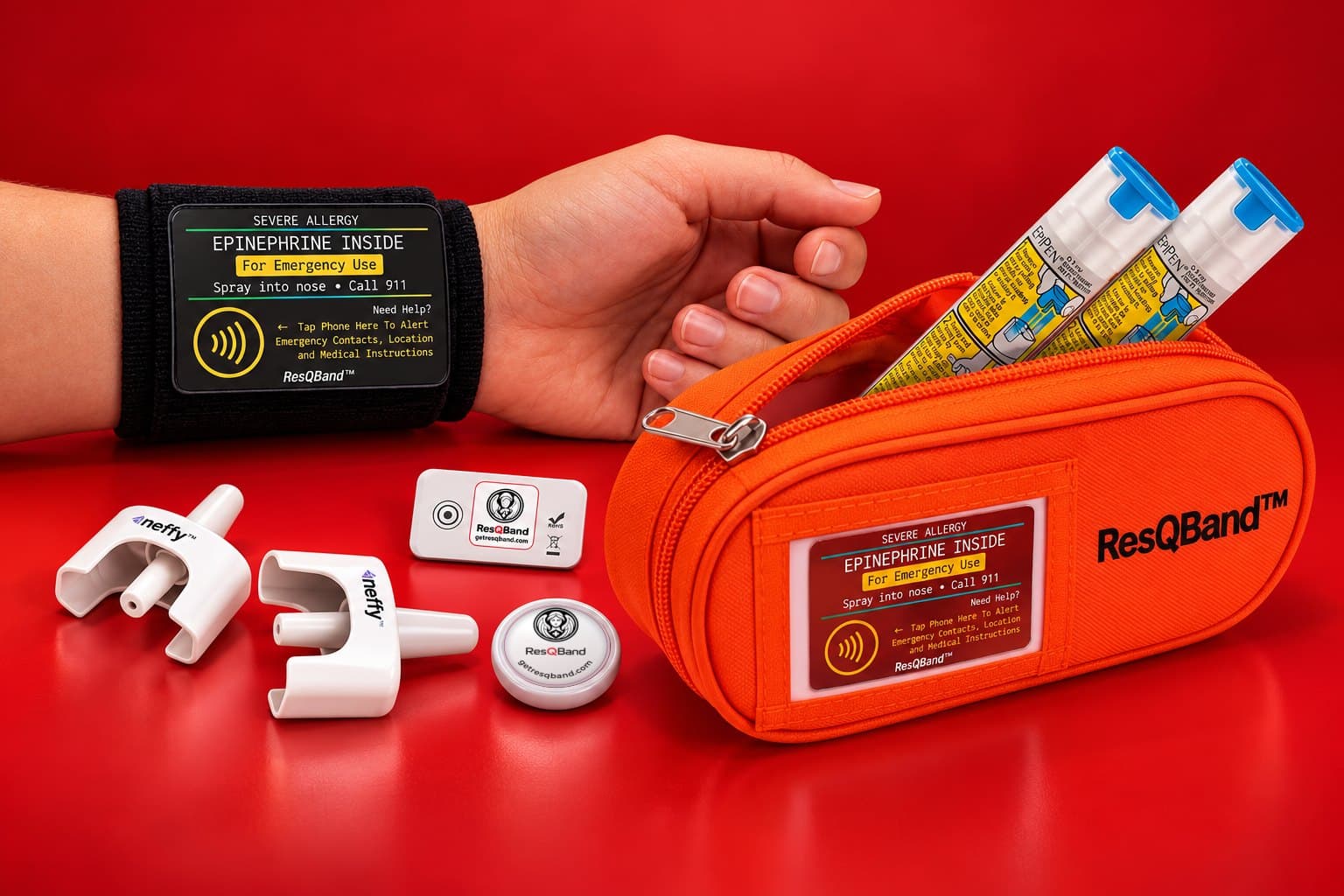
From ResQBand
Knowledge helps. So does a plan for the moment it matters.
A tap on the ResQBand Tap Card opens your emergency steps and a Call 911 button on most phones, and the helper can alert your emergency contacts with one more tap. The kit adds a tracker, a temperature disc and a thermal pack for your epinephrine.
General information, not medical advice. We link to other organizations' resources; we don't control them, and a listing isn't an endorsement. Summaries marked as AI summaries are written by an AI model from the source and can miss nuance, so read the original before acting on anything. In an emergency, use epinephrine and call 911.