The latest on food allergy and anaphylaxis from Canadian, US and international sources: policy and labelling, schools, airlines and life with allergies. Updated every morning, each with a short summary and a link to the original.
AI summaryCongress member who is an allergist introduced legislation to prevent insurance companies from blocking access to essential allergy and asthma treatments.
AI summaryA flight attendant's midair anaphylaxis revealed gaps in airline epinephrine training and emergency preparedness when a bystander doctor had to intervene.
AI summaryThree young researchers are receiving $150,000 to study lifelong allergies, anaphylaxis prevention, and improved diagnosis using artificial intelligence.
AI summaryA person with a severe peanut allergy was allegedly targeted in an attack involving peanut butter during a divorce dispute, raising safety concerns.
AI summaryA jury awarded over $1 million to a boy and his mother in a federal lawsuit over an allergic reaction to nuts in a cookie, highlighting the serious consequences of allergen exposure and food safety failures.
AI summaryThree cases of anaphylaxis from hidden allergens in energy drinks show how unexpected ingredients can trigger severe reactions even when standard allergy tests are negative.
Testing and diagnosisLabels and recallsEveryday life
AI summaryAn advocacy campaign challenges the assumption that peanut allergies are the only serious food allergies, noting that milk causes the most fatal food-allergic reactions in school-aged children in the UK.
AI summaryA national survey found schools without stock epinephrine are four times more likely to lack medication during allergic emergencies, raising questions about safety and family costs.
AI summaryNFL legend Drew Brees shares his personal experience with food allergies and emphasises the importance of awareness and emergency preparedness.
Everyday lifeAdvocacy and policy
Case report · The journal of medical investigation : JMI · Nov 11
AI summaryA case report describes a woman who experienced anaphylactic shock from cefmetazole during dental surgery, highlighting that refractory hypotension without initial skin symptoms can signal anaphylaxis under general anaesthesia and requires prompt adrenaline treatment.
AI summaryA Colorado court awarded $1.55 million after a child was hospitalised by undisclosed hazelnuts in a chocolate wafer product, holding the food distributor liable.
Labels and recallsAdvocacy and policy
Study · Pediatric allergy, immunology, and pulmonology · Nov 10
AI summaryA 13-year-old with acid sphingomyelinase deficiency successfully restarted enzyme replacement therapy after anaphylaxis by using a 12-step desensitisation protocol, reaching full therapeutic dose without recurrent reactions.
AI summaryAllergy UK held a November business forum where food industry and allergen management professionals discussed Codex standards and best practice for allergen management.
AI summarySome adults develop food allergies later in life, with peanut allergy beginning in one woman's 40s. The reasons for rising adult-onset food allergy are not yet clear.
AI summaryGuidance for people with tree nut allergies ordering seasonal food and drinks: check full recipes including syrups and sauces, confirm preparation methods, and discuss cross-contamination with staff.
AI summaryPediatric allergist explains how accurate diagnoses, emergency plans, and age-appropriate education help protect students with food allergies at school.
School and childcareTesting and diagnosisEpinephrine
Review · The journal of allergy and clinical immunology. In practice · Nov 2
AI summaryFARE hosted community convenings in 2024 and 2025 bringing together stakeholders to address food allergy inequity in minoritized populations with less access to care and education.
AI summaryA parenting contributor shares advice on types of friends that food allergy parents need on their journey. A podcast blog post about social support.
AI summaryAn FAA proposal may weaken airline protections for anaphylaxis by letting airlines decide whether to carry epinephrine, putting passengers at risk.
AI summaryDiscrepancies between traveller reports and airline data suggest anaphylaxis reactions on flights are more common than official airline records indicate.
AI summaryAn urgent care clinic in Virginia demanded payment before administering epinephrine to a woman in anaphylaxis, raising concerns about access to lifesaving treatment.
AI summaryPennsylvania becomes the eighth state to enact Elijah's Law, which strengthens anaphylaxis preparedness and access to epinephrine in childcare settings.
AI summaryAllergy UK and partners are advocating for improved school allergy safety guidance in Northern Ireland, where current guidance is significantly outdated.
AI summaryNew restaurant allergen disclosure laws are increasing expectations for ingredient transparency, staff training and food allergy safety in dining establishments.
AI summaryPennsylvania has signed Elijah's Law requiring childcare centres to train staff on food allergy. The law aims to improve safety for young children with allergies in childcare settings.
AI summaryThe UK's medicines regulator is consulting on allowing schools to stock spare adrenaline nasal sprays for emergencies, alongside existing spare auto-injectors. About 20% of serious food allergy reactions happen in schools.
AI summaryA 24-year-old died from anaphylaxis after café staff repeatedly told him peanut-contaminated food was safe. The death highlights risks when food handlers ignore allergy warnings.
The UK’s first needle-free adrenaline nasal spray, EURneffy® 1mg, is now available on prescription for younger children at risk of serious allergic reactions.
Photo credit: Mast cells, Zoe Whyte, Mast cells, used with permission Mast cell diseases can go unnoticed by almost everyone, yet be unmistakable to the person living with one.
Testing and diagnosisSchool and childcareAdvocacy and policy
Social media's latest wellness craze is sending Australians to emergency departments with serious complications, including potentially life-threatening anaphylaxis.
A global panel proposes sweeping changes to food allergy warnings, replacing confusing labels with science-based standards for unintended allergen contamination.
Leo was born on 14 October 1992 and grew up as a fit, active young man who loved football, rugby and the outdoors. Although he had asthma as a child, there was no indication that he was living with a serious allergy until he was 20 years old.
Transforming Allergy Care: The First National Allergy Capability Framework is launched The British Society for Allergy & Clinical Immunology (BSACI) has launched the National Allergy Capability Framework (ACF) , a landmark initiative designed to establish a…
Testing and diagnosisSchool and childcareAnxiety and mental health
Vacationers should be aware that allergy-friendly options at Walt Disney World restaurants may now include some ingredients previously classified as ...
Allergy & Anaphylaxis Australia recommends medical identification jewellery for people at risk of anaphylaxis. The post Medical identification jewellery first appeared on Allergy & Anaphylaxis Australia .
Guide to thousands of gluten-free products with allergen processing information provided directly by the manufacturer, including gluten-free certifications.
AI summaryA case report describes a 62-year-old man who experienced anaphylaxis from wasp stings followed by a heart attack; the temporal relationship suggests a rare condition where allergic reactions can trigger acute coronary events.
Nerve cells may remember allergens, helping explain why allergies develop after repeated exposures and why sensitivities can multiply.
Everyday life
Questions
Where does this news come from?
From allergy news sites and organizations such as Allergic Living, SnackSafely.com, Food Allergy Canada and Anaphylaxis UK, plus health news feeds from Health Canada, the FDA and others, filtered for allergy stories. Every item links to the original.
Are food recalls included?
Food allergen recalls are in the free ResQBand app, matched to your allergies, straight from Health Canada and the CFIA, the FDA and the USDA. Open the app's Food safety section to see them, no account needed.
Who writes the summaries?
An AI model writes the one or two sentence summaries from the source's own text, and they're labelled as AI summaries. They can miss nuance, so read the original before acting on anything.
Knowledge helps. So does a plan for the moment it matters.
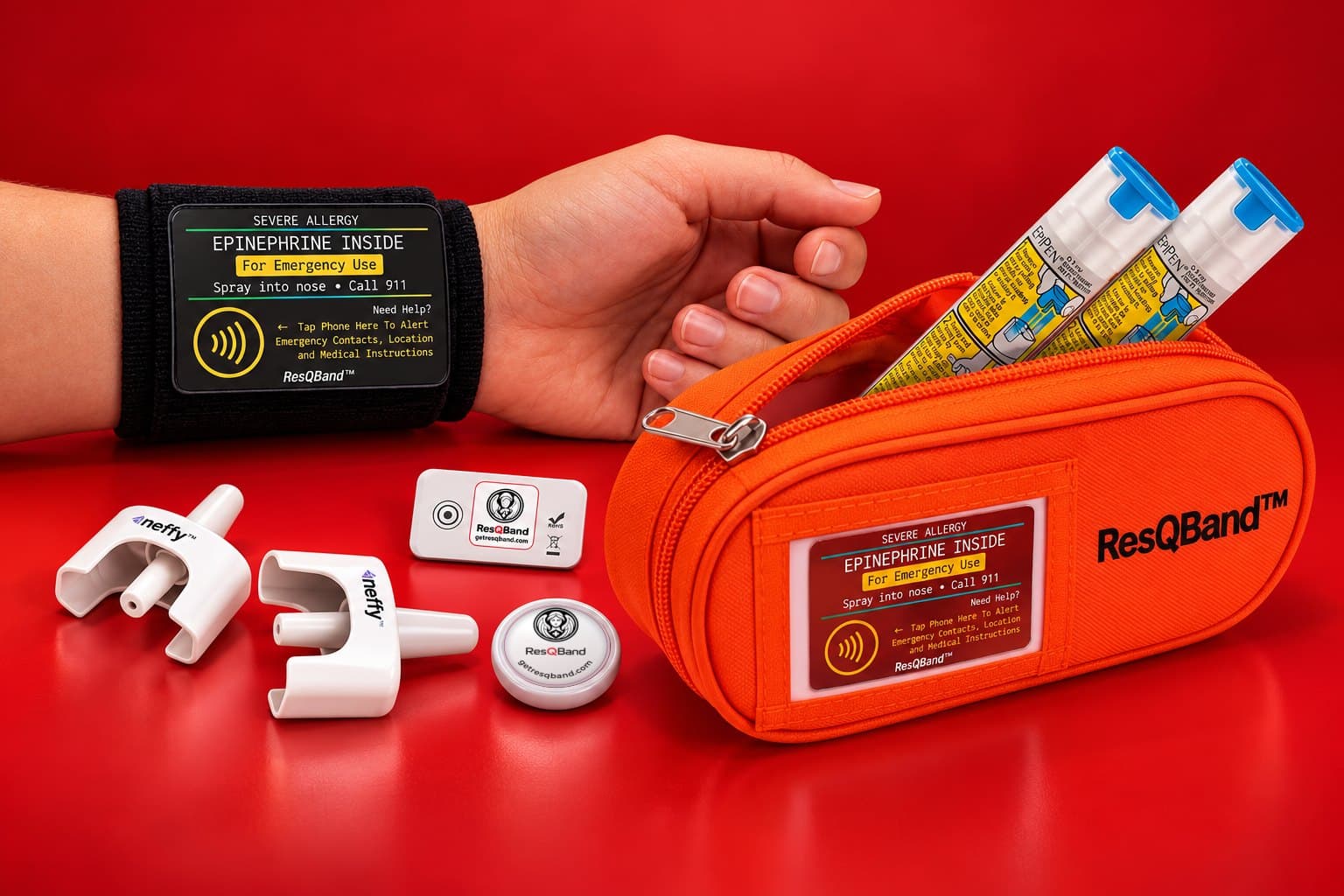
A tap on the ResQBand Tap Card opens your emergency steps and a Call 911 button on most phones, and the helper can alert your emergency contacts with one more tap. The kit adds a tracker, a temperature disc and a thermal pack for your epinephrine.
General information, not medical advice. We link to other organizations' resources; we don't control them, and a listing isn't an endorsement. Summaries marked as AI summaries are written by an AI model from the source and can miss nuance, so read the original before acting on anything. Something out of date or missing? Email info@westernallergy.com. In an emergency, use epinephrine and call 911.