

Forgot EpiPen again? How to stop leaving it behind
Epinephrine gets left behind when routines change, not because anyone is careless. The habits that help, and how a tracker on the kit can ping your phone.
By ResQBand team · Fact-checked by Western Allergy Services Ltd., Canadian allergy company since 1972
· Updated October 30, 2026 · 3 min read
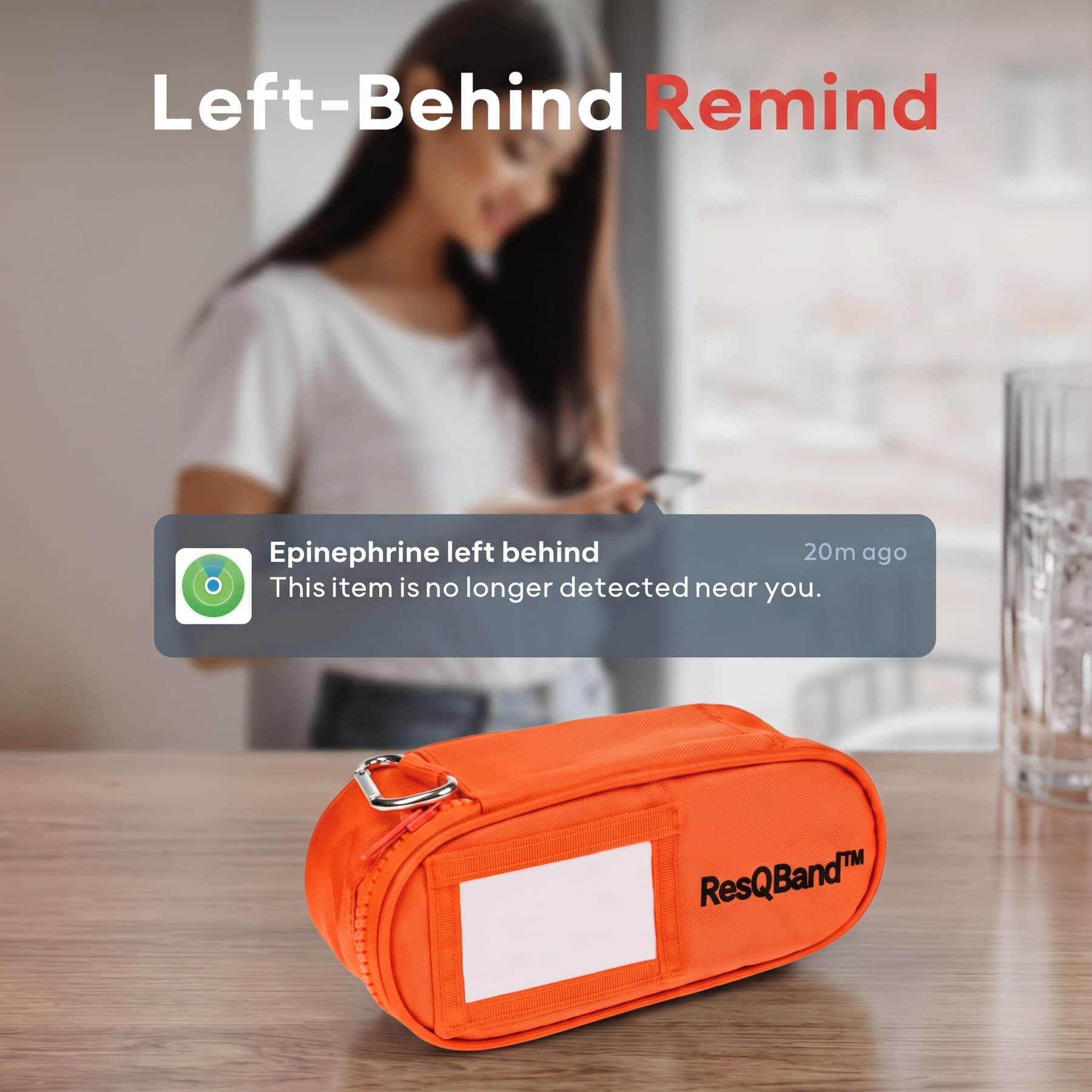
Every allergy family knows the feeling. You are twenty minutes down the highway, or the food has just arrived, when someone asks: "Who has the allergy bag?" If you forgot the EpiPen at home today, you are in good company. It almost never happens because someone doesn't care. It happens because a routine changed.
Forgot EpiPen? Why epinephrine gets left behind
Memory runs on routine. The kit goes in the same backpack every morning, so nobody has to think about it. Then something shifts:
- The kit moves from the school backpack to a weekend bag, and doesn't move back.
- A different parent does the drop-off.
- A teen changes jackets when the weather turns.
- The bag gets hung on a restaurant chair or set down at the rink.
- It's a sleepover, a tournament or a holiday, and nothing is where it usually is.
Each of those breaks the habit for one day, and one day is all a reaction needs.
Having it is half of it
Carrying the kit is the first step. Someone using it is the second. A Canadian study of 483 cases of food-induced anaphylaxis at nine emergency departments found that only 41% of patients who had an auto-injector with them used it before reaching hospital (Gabrielli et al., 2018). So the goal is two things: the kit is there, and the person beside it knows what to do.
Habits that keep the kit with you
- One home for the kit. The same hook, shelf or bowl by the door, every time it comes into the house.
- Move it last, move it back. When you switch bags, the kit moves last on the way out and first on the way in.
- Two kits where it makes sense. One that lives at school or in the sports bag, one that travels. Guidelines recommend carrying two doses, and neffy's maker advises carrying at least two.
- Ask before the car moves. A one-word check ("kit?") before you pull out of the driveway catches most misses.
- Hand the habit to teens gradually. Agree on where it lives, then check less often as it sticks.
How a left-behind alert works
Your phone is the one thing you rarely forget, because you would notice within minutes. A left-behind alert uses that. A small tracker rides in the epinephrine kit, and your phone keeps an eye on it. When you walk away and the kit stays put, your phone tells you, usually before you are far down the street.
On iPhone, Find My can notify you when you leave an item behind, and you can set places where you don't want alerts, like home. On Android, left-behind alerts depend on the phone and the tracker. Every version still shows the kit on a map and can make it ring.
The Forget-Me-Not Epi Tracker
We made the Forget-Me-Not Epi Tracker for epinephrine kits. It comes in an iPhone version and an Android version, and you pick one at checkout. It joins the finder app already on your phone, so the kit shows on the map beside your other things and can be made to ring when it has gone missing in the house.
- On iPhone, and on Android phones that support left-behind alerts, it pings your phone when you walk away without it.
- Family on the same platform can be shared on it, so a parent or caregiver can see where the kit is.
- It runs on a standard replaceable battery, about a year per battery by the manufacturer's estimate. Nothing to charge.
- It is slim enough to ride in the ResQBand Wrist Band pocket or clip inside the Thermal Pack.
Three places a tracker earns its keep
- The school backpack. You find out on Monday morning, not at lunch, that the kit came out on Friday and never went back.
- A teen's sports bag. Fewer "do you have it?" texts, and the teen gets the reminder instead of you.
- Restaurants and travel. The chair, the booth, the airport gate: the places a bag gets set down and forgotten.
Pair it with instructions
A tracker helps the kit be there. The ResQBand Tap Card helps whoever is beside it use it: tapped with most phones, it tells the helper to use the epinephrine now and call 911, opens the maker's instructions with one press, and gives them a button to alert you by text with their location. Alerts are free once the card is registered, with no subscription.
A tracker is a reminder, not a promise: alerts depend on your phone and its settings. Keep the habits too. In an emergency, call 911.
Sources
- Epinephrine underused during anaphylaxis outside of hospital (Gabrielli et al., JACI: In Practice), McGill University Health Centre (2018)
- Get notified if you leave an item behind (Find My on iPhone), Apple Support (2026)
- AirTag alternatives for Android, Android.com (2026)
- neffy frequently asked questions, ALK Canada (neffy.ca) (2026)
General information, not medical advice. Always follow the instructions that come with your medication and the advice of your pharmacist or doctor. In an emergency, call 911. Medical disclaimer · How we check our articles