

Epinephrine storage temperature: EpiPen and neffy limits
What the labels say about heat and cold, where epinephrine actually gets too hot or too cold, and how to know when it happened.
By ResQBand team · Fact-checked by Western Allergy Services Ltd., Canadian allergy company since 1972
· Updated November 15, 2026 · 3 min read
Epinephrine has to go everywhere your family goes: hockey rinks in January, cars in July, beach bags and ski hills. That makes epinephrine storage temperature one of the hardest parts of carrying it. Here is what the labels for EpiPen and neffy actually allow, and how to keep a device inside those limits.
Epinephrine storage temperature: what the labels say
| EpiPen auto-injector | neffy nasal spray | |
|---|---|---|
| Storage range | 20 to 25°C, with brief excursions from 15 to 30°C (US labelling). Check the leaflet in your package for the range it states. | 15 to 30°C, for up to 30 months, with excursions up to 50°C permitted (Canadian product monograph). |
| Cold | Don't keep it in a fridge or a car's glove box, or expose it to extreme heat or cold. | Don't freeze it. neffy freezes below -15°C and won't deliver epinephrine while frozen. |
| Light and handling | Keep it in its carrier tube, protected from light. | The maker says it's best kept at room temperature. |
| Checking it | Look at the solution now and then. Replace it if it turns pinkish or brown, or has particles in it. | Check the expiry date on the device and box. |
If neffy freezes
The patient leaflet says to let a frozen neffy thaw at room temperature for at least an hour, and not to use it until it has thawed completely. In an emergency, the monograph's advice to professionals is not to wait for it to thaw but to get emergency medical care right away. In practice: keep neffy from freezing in the first place, carry a second device, and call 911.
Where epinephrine gets too hot or too cold
- A parked car. Summer heat builds inside a closed car fast, and the glove box is one of the worst places in it.
- The rink, the ski hill and the walk to school. A bag on a bench or an outside pocket gets as cold as the air.
- A beach or dock bag. Direct sun on a dark bag can push past the label's upper limit.
- The trunk on a road trip. Out of sight, and often the hottest or coldest place in the car.
Keeping it in range
- Carry it close. In winter, an inside pocket or a case worn under a jacket stays warmer than a bag.
- Keep it out of the sun. Shade makes a real difference on a hot day.
- Never leave it in the car. It comes in with you.
- Use an insulated case. Insulation slows heat and cold. It won't hold a temperature for long, but it buys time.
- If in doubt, ask. If a device may have gone outside its range, your pharmacist can tell you whether to replace it.
The ResQBand Thermal Pack
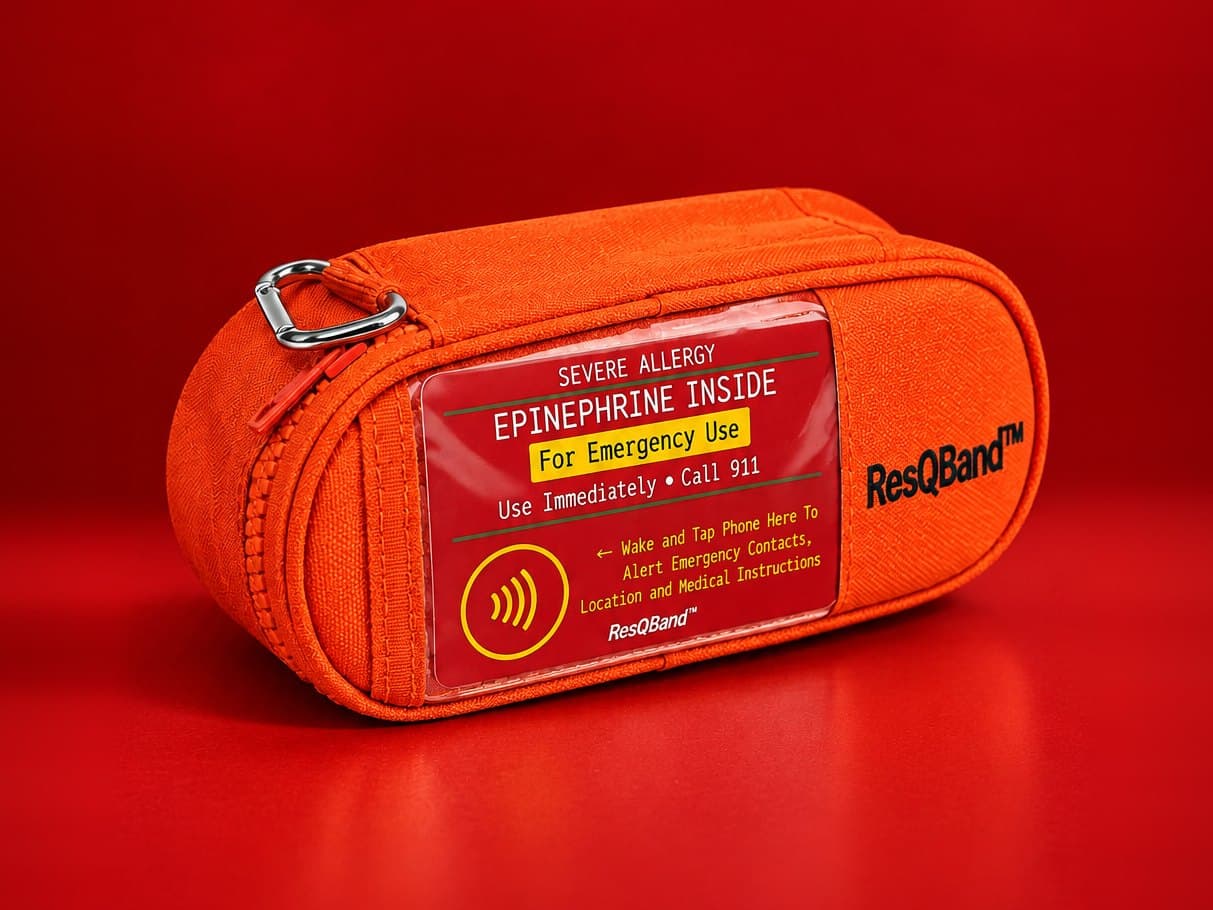
The ResQBand Thermal Pack is a high-visibility rescue-orange case with a foil-lined insulated shell that slows heat and cold. It is insulation, not a cooler: there are no gel packs or refrigerant. It fits two auto-injectors or a 2-pack of nasal spray, plus the Forget-Me-Not Epi Tracker, and the Tap Card rides in the front sleeve so a helper can tap it without opening the case. A carabiner clips it to a bag, belt or stroller.
Knowing when it went out of range
Insulation slows the change. It doesn't tell you when the line was crossed. The Temp-Alert Disc is a slim, sealed temperature disc that rides with the epinephrine. With the free ResQBand app open on a phone in range, it alerts the phone when a reading leaves the range you set, and it can send email alerts too.
- Set the alert range to the storage range printed on your medication's label.
- Readings the app collects are kept in your ResQBand account as a chart and a spreadsheet, to show a school, a camp or a pharmacist.
- It is accurate to plus or minus 0.5°C from 0 to 60°C, water-resistant (IP67) and weighs 7 g.
- Its wireless range is up to 150 m in open air. It isn't Wi-Fi or cellular, so the phone has to be in range.
The short version
Know your device's range, keep it with you and out of the car, give it an insulated case, and get an alert when it drifts. When in doubt about a device that got too hot or too cold, ask your pharmacist about replacing it.
Storage limits come from each maker's labelling, summarised here. Always follow the leaflet in your own package. In an emergency, call 911.
Sources
- neffy product monograph (Canada), ALK-Abelló / Health Canada (2026)
- neffy frequently asked questions, ALK Canada (neffy.ca) (2026)
- EpiPen safety and storage, EpiPen.com (2026)
General information, not medical advice. Always follow the instructions that come with your medication and the advice of your pharmacist or doctor. In an emergency, call 911. Medical disclaimer · How we check our articles