

Nasal epinephrine spray vs auto-injector: a Canadian study
After practising with trainers of both, 83% of 90 Canadians in a study with ALK authors preferred a nasal epinephrine spray to an auto-injector, mostly because it was easier to carry.
By ResQBand team · Fact-checked by Western Allergy Services Ltd., Canadian allergy company since 1972
· Updated October 20, 2026 · 5 min read
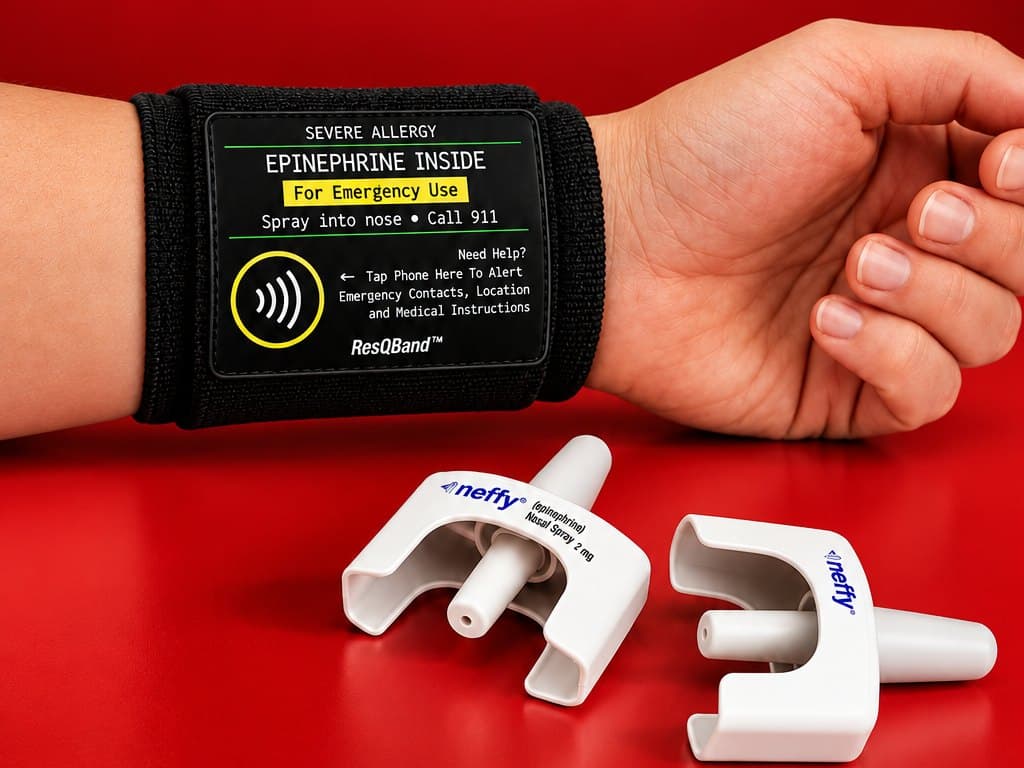
In Canada, epinephrine for anaphylaxis now comes two ways: the familiar auto-injector, such as EpiPen, and neffy, a nasal spray authorized in 2026. Which do people actually prefer? Four posters at the Canadian Society of Allergy and Clinical Immunology (CSACI) meeting in Toronto in October 2026 reported on one Canadian study that compared nasal epinephrine spray vs auto-injector, head to head. The short answer: after trying both, most participants preferred the nasal spray, mainly because it was easier to carry and felt easier to use. But the study measured what people thought, not how well either device works in a real emergency.
How the study worked
- Who: 90 Canadians, studied in May and June 2026. That was 30 adults and 30 teens aged 13 to 17 (in each group, 15 with a severe allergy who'd been prescribed an auto-injector and 15 with no allergy), plus 30 caregivers of the teens.
- What they did: adults and teens used trainer versions of both devices, in alternating order, while caregivers watched. Then everyone watched instructional videos, tried both trainers again, and read about each device's effectiveness, medication checks, shelf life, storage and disposal.
- What they rated: statements about carrying, everyday life and willingness to use, each on a 1 to 5 scale, and finally which device they would prefer to have.
- Starting point: everyone knew about auto-injectors, and nobody had seen the nasal spray before.
Nasal epinephrine spray vs auto-injector: the results
Preference. 83% (75 of 90) preferred the nasal spray. It ranged by group, from 93% of adults with a severe allergy down to 67% of teens with a severe allergy, who were the most likely to stick with the device they already carried.
Carrying. Seven statements, with the biggest gaps here (the share who agreed or strongly agreed):
| Statement | Nasal spray | Auto-injector |
|---|---|---|
| I could bring it to any activity without planning how to carry it | 83% | 33% |
| It feels compact and easy to carry | 99% | 52% |
| I could have it with me during sports and physical activities | 93% | 48% |
| I could carry it without feeling self-conscious about my allergy | 84% | 47% |
| Carrying it would give me peace of mind | 98% | 96% |
Everyday life. For each of nine lifestyle statements, 89 to 100% agreed about the nasal spray, compared with 61 to 84% for the auto-injector. The biggest differences were the device fitting easily into everyday life and not getting in the way of what people like to do, 32 points each.
Willingness to use. Across six statements, 94 to 100% agreed for the nasal spray and 68 to 88% for the auto-injector. The biggest gaps were being willing to give a second dose 5 minutes later if needed (100% vs 71%) and being comfortable using it whatever was going on around them (94% vs 68%). 98% said they'd feel comfortable deciding to use the nasal spray on their own, against 78% for the auto-injector.
Why people chose one or the other
Participants who preferred the nasal spray said it was smaller, lighter and easier to fit in a pocket or small bag; that it was needle-free and less frightening; that it was intuitive and fast; and that it seemed easier for a bystander, with fewer steps to go wrong.
Those who preferred the auto-injector mostly named familiarity, from school, videos or their own use. Some found an injection reassuring, or didn't like the idea of putting a device in the nose.
Who was behind the study
Read it with the source in mind. The posters don't include a funding statement, but the author list tells you a lot. Two of the authors work for ALK-Abelló, the company that sells neffy in Canada, and four are from Designpsykologi, a design psychology firm in Copenhagen. The academic authors were Douglas P. Mack of McMaster University in Hamilton, Jennifer L.P. Protudjer of the University of Manitoba and Shelley Dua of Cambridge University. The posters don't name the product, but ALK's nasal spray is neffy. ALK also reported an earlier crossover study of 90 people, presented at a US allergy meeting in early 2026, in which 88% preferred the nasal spray.
What the study can and can't tell you
- It measured perceptions after practising with trainer devices, not real emergencies.
- Preference isn't effectiveness. The study didn't test how well either device works in a real reaction. Both are approved treatments.
- The authors say prospective studies are needed to see whether these preferences turn into carrying epinephrine more often and using it sooner.
Why it still matters: epinephrine only helps if it's there and someone uses it. In a US survey covering 917 people prescribed auto-injectors, only 44% always carried at least one (Warren et al., 2018). And early epinephrine is linked to fewer hospital admissions: in a US children's emergency department study, 17% of children given epinephrine before arriving were admitted, compared with 43% of those who first got it at the hospital (Fleming et al., 2015). A device people are willing to carry and use could help on both counts.
Which one is right for you?
That's a decision for you and your prescriber. A few facts to bring to the conversation:
- In Canada, neffy 2 mg is authorized for people who weigh 30 kg (66 lb) or more. Auto-injectors come in a lower dose for smaller children.
- Outside Quebec, neffy currently needs a prescription, while auto-injectors don't. That's under review: see do you need a prescription for neffy in Canada?
- Whichever you choose, carry two.
Carrying either one with ResQBand
We make carrying gear for both. The ResQBand Wrist Band holds a single-dose nasal spray, the Tap Card and the tracker on the wrist. The Thermal Pack fits two auto-injectors or a nasal spray 2-pack. And the Tap Card comes in two versions, the black card printed "Spray into nose" and the red card printed "Use immediately", so whoever helps knows what to do with the device in the bag. Our guide to explaining neffy to a babysitter covers the three mistakes helpers make with a nasal spray.
Disclosure: our pharmacy partner sells both neffy and EpiPen through the ResQBand shop.
About the study
Four posters at the 81st CSACI Annual Scientific Meeting (Toronto, October 2026) reported this study: #6113 on preference (lead author Douglas P. Mack), #6114 on carrying (Jennifer L.P. Protudjer), #6115 on willingness to use (Shelley Dua) and #6116 on lifestyle fit (Sarah Lacquiere, ALK). Poster results are early findings.
This article summarises research for general information. It isn't medical advice: talk to your prescriber about which device suits you. In an emergency, call 911.
Sources
- Poster: Nasal epinephrine spray is preferred over the epinephrine autoinjector in a Canadian comparative study (Mack DP, Protudjer JLP, Dua S, et al.), 81st CSACI Annual Scientific Meeting, Toronto (2026)
- Poster: Patients and caregivers perceive nasal epinephrine spray as easier to carry than an epinephrine autoinjector (Protudjer JLP, Mack DP, et al.), 81st CSACI Annual Scientific Meeting, Toronto (2026)
- Poster: Greater willingness to use nasal epinephrine spray versus epinephrine autoinjector in a Canadian comparative study (Dua S, Mack DP, et al.), 81st CSACI Annual Scientific Meeting, Toronto (2026)
- Poster: Canadian patients and caregivers perceive nasal epinephrine spray as a better lifestyle fit than an epinephrine autoinjector (Lacquiere S, Mack DP, et al.), 81st CSACI Annual Scientific Meeting, Toronto (2026)
- 81st Annual CSACI Scientific Meeting, Toronto, October 15 to 18, 2026, Canadian Society of Allergy and Clinical Immunology (2026)
- New data reveals 9 in 10 people prefer a needle-free nasal adrenaline spray over auto-injectors, ALK-Abelló (2026)
- Study: epinephrine management in children and adults (Warren et al., Annals of Allergy, Asthma & Immunology), FARE (2018)
- Early epinephrine treatment in anaphylaxis associated with reduced risk of hospitalization (Fleming et al., JACI: In Practice), HCPLive (2015)
- neffy product monograph (Canada), ALK-Abelló / Health Canada (2026)
- neffy epinephrine nasal spray: FAQs, Food Allergy Canada (2026)
General information, not medical advice. Always follow the instructions that come with your medication and the advice of your pharmacist or doctor. In an emergency, call 911. Medical disclaimer · How we check our articles