

Medical ID for allergies: tap cards vs bracelets
Engraved bracelets, membership services, phone medical IDs and tap cards: what each one tells a helper, what it costs over time, and why many families use two.
By ResQBand team · Fact-checked by Western Allergy Services Ltd., Canadian allergy company since 1972
· Updated October 21, 2026 · 3 min read
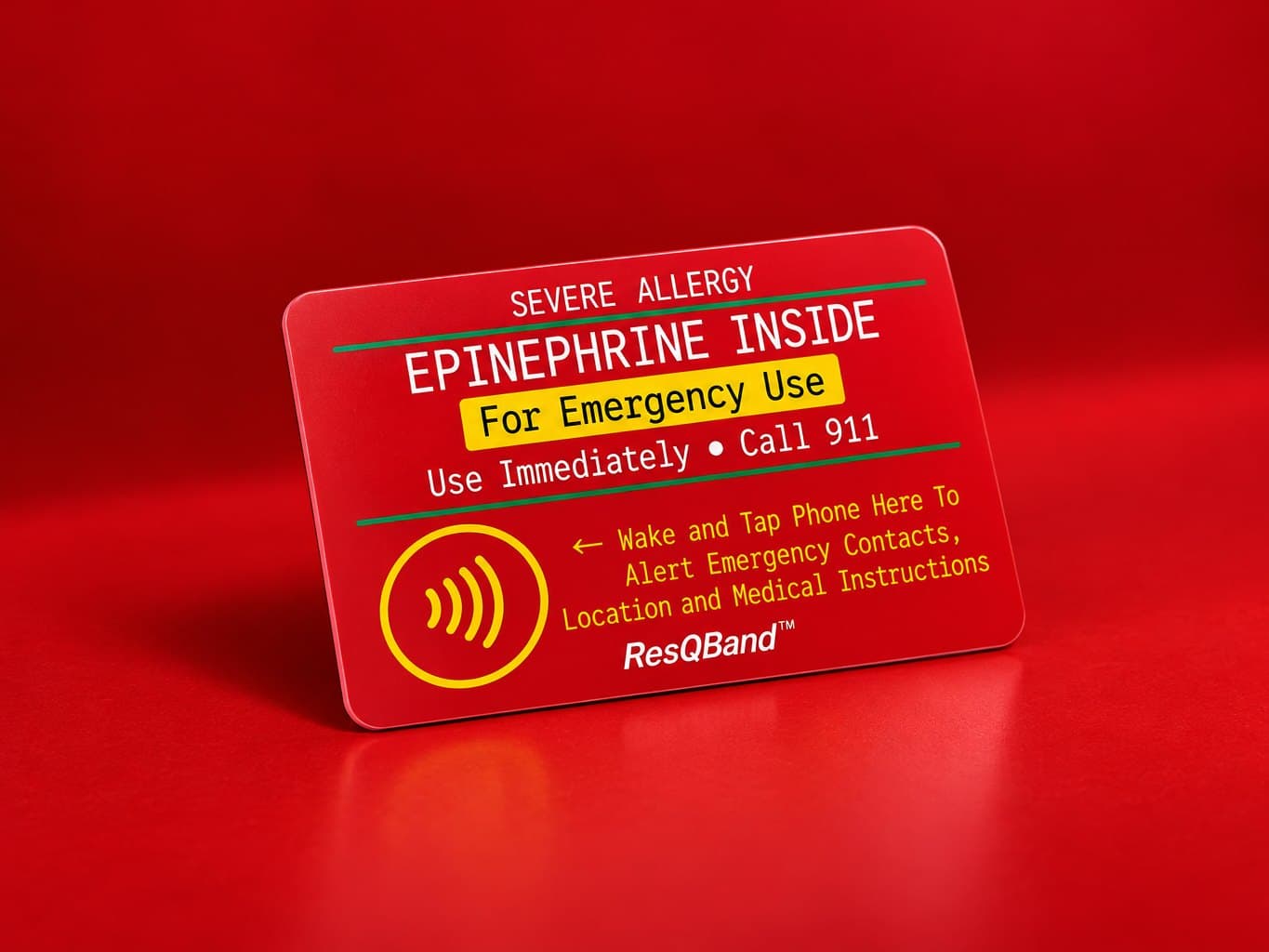
When someone is diagnosed with a severe allergy, one of the first suggestions is to wear medical identification. Today there are more kinds of medical ID for allergies than an engraved bracelet, and they do different jobs. The useful question isn't which one is best. It is what the person beside you can actually see and do with it in the first minutes of a reaction.
The four kinds of medical ID for allergies
- Engraved bracelets and necklaces. Always on the body, no battery, no phone needed, and paramedics are trained to look for them. They hold a few short lines of text, and changing the text means a new engraving.
- Membership services. A bracelet or card with a number that responders can call for your medical details. Food Allergy Canada has featured this kind of service for families at school. Most charge an annual fee to keep the service active.
- Your phone's built-in medical ID. iPhone and Android phones can show medical details from the lock screen. It costs nothing, but it only helps if your own phone is with you and charged, and if the helper knows to look.
- NFC tap cards. A card the helper taps with their own phone to open a page. It can show more than engraving can, and it can be updated any time. It needs a helper with a phone that reads tap cards, which most phones do.
Side by side
| ResQBand Tap Card | Engraved ID | Membership service | Phone medical ID | |
|---|---|---|---|---|
| Works with no phone | Yes, as a printed card | Yes | Yes, as an engraving | No |
| Tells a helper what to do | The device steps from its maker, and Call 911 | A few words | Through a phone call | Only what you typed |
| Lets the helper reach your family | A button the helper presses to text your contacts, with their location when their phone allows it | No | Through the service | No |
| Changing the details | Online, any time | New engraving | Online or by phone | On the phone |
| Ongoing cost | None: alerts are free once the card is registered | None | Annual fee | None |
What an engraving can't do
"Peanut allergy, carries epinephrine" tells a helper what is wrong. It doesn't show a frightened grandparent, coach or stranger what to do with the device in the bag. That is the gap a tap card fills.
When the helper taps a ResQBand Tap Card, most phones open the person's emergency page (newer iPhones, and Android phones with tap-to-pay turned on). There is no app, no login and no camera involved. The page tells them to use the epinephrine now, then call 911, and opens the maker's step-by-step instructions with one press: the EpiPen steps for the red card, or the neffy steps for the black card. It shows the person's allergies, where the epinephrine is, and what to tell the 911 dispatcher.
Reaching your family fast
With an engraving, nobody knows anything happened until someone finds time to call. On a ResQBand page, the helper can press a button that alerts the owner's two emergency contacts by text, with the helper's location when their phone allows it. Nothing is sent until they press it, and contacts opt in themselves first. Contacts can also choose a phone call with each alert. It works even when the owner's own phone is dead or locked, because the helper's phone does the work.
Cost over the years
An engraved bracelet is a one-time purchase. Membership services usually charge every year to keep your profile active, which adds up over a childhood. A ResQBand Tap Card is a one-time purchase with no subscription: the emergency page, the alerts and the school share links are included once the card is registered.
Why many families use two
A tap card and a bracelet don't compete. A bracelet is on the wrist at the pool and in the shower. A card in the wallet, on the backpack or in the Wrist Band window carries the instructions and the alert button. For a child who carries epinephrine, the combination covers both jobs: telling people what is wrong, and showing them what to do about it.
Whichever you choose, make sure it says the person carries epinephrine and where it is. Try the demo of what a helper sees, or read how a ResQBand card differs from a medical ID bracelet.
Medical ID helps a helper act sooner. It doesn't replace an emergency plan or epinephrine. In an emergency, call 911.
Sources
- A medical ID tells others about your child's food allergies, Food Allergy Canada (2018)
- How to use EpiPen, EpiPen Canada (2026)
- How to use neffy, ARS Pharmaceuticals (neffy.com) (2026)
General information, not medical advice. Always follow the instructions that come with your medication and the advice of your pharmacist or doctor. In an emergency, call 911. Medical disclaimer · How we check our articles