

Anaphylaxis deaths in Canada: what a new registry found
McGill researchers gathered the anaphylaxis deaths in eight provinces from 2020 to 2025. Deaths were rare, but more than a quarter of the people who died never got epinephrine.
By ResQBand team · Fact-checked by Western Allergy Services Ltd., Canadian allergy company since 1972
· Updated October 22, 2026 · 4 min read
Anaphylaxis deaths in Canada are rare, but until now nobody had counted them nationally. A new registry, the Cross-Canada Registry for Anaphylaxis Fatalities (CRAFT), set out to do that. Led by researchers at McGill University and presented at the Canadian Society of Allergy and Clinical Immunology (CSACI) meeting in Toronto in October 2026, it gathered anaphylaxis deaths in eight provinces from January 2020 to December 2025. The headline: 54 deaths met the international definition of anaphylaxis, and more than a quarter of those people never received epinephrine.
Anaphylaxis deaths in Canada: the key numbers
- 62 deaths identified, 54 confirmed. Each case was checked independently by two reviewers and confirmed by an allergist against the 2024 GA²LEN consensus definition of anaphylaxis.
- Mostly adults. 46 adults and 8 children. The median age was 41.5 years, and half were male.
- Epinephrine was given in 73.6% of the cases where it was recorded (39 of 53). Put the other way: more than one in four people who died didn't get epinephrine.
- Other health conditions were common. Three in four of the people whose records showed it had at least one, mainly asthma or heart disease.
- Co-factors showed up in some cases: alcohol in 5, cannabis in 4 and other drugs in 4.
What triggers fatal anaphylaxis: food in children, stings in adults
- Children: in all 7 child deaths with a known trigger, the trigger was food. Milk was the most common, in 4 of those 7.
- Adults: insect venom from stings accounted for 25 of 41 adult deaths (61%). The registry also recorded deaths from food, drugs, and other or unknown triggers.
The milk finding stood out. Among the registry's recommendations is more education for families, schools and professionals, including about milk as a hidden allergen.
Which provinces have the highest anaphylaxis death rates?
| Province | Deaths, 2020 to 2025 | Deaths per million people per year |
|---|---|---|
| Saskatchewan | 5 | 0.68 |
| Nova Scotia | 2 | 0.31 |
| Quebec | 15 | 0.28 |
| Ontario | 24 | 0.25 |
| British Columbia | 6 | 0.18 |
| Alberta | 2 | 0.07 |
| Prince Edward Island | 0 | 0 |
| Newfoundland and Labrador | 0 | 0 |
Most provinces were well below the US benchmark of 0.69 deaths per million people a year shown on the poster; Saskatchewan was close to it. Its rate was about three times the rest of Canada's (rate ratio 3.06; 95% confidence interval 1.26 to 7.46), and the authors call for its gaps in allergy care to be addressed. Five deaths is a small number, so that estimate is uncertain, but the confidence interval for the rate ratio stays above 1.
No anaphylaxis deaths were recorded in Prince Edward Island or Newfoundland and Labrador over the six years. Manitoba, New Brunswick and the territories weren't part of the registry.
Why epinephrine still gets missed
The CRAFT team started from the idea that delayed or absent epinephrine is one of the main contributors to anaphylaxis deaths, along with weak policies in public places like schools and restaurants. Their numbers fit a pattern Canadian research has shown before:
- An Ontario review of 92 anaphylaxis deaths from 1986 to 2011 found epinephrine was given before cardiac arrest in only about a quarter of cases (Xu et al., 2014).
- A study of 483 food-induced anaphylaxis cases at nine Canadian emergency departments found only 41% of people who had an auto-injector with them used it before reaching hospital, while 53% were given antihistamines (Gabrielli et al., 2018).
Epinephrine is the first-line treatment in anaphylaxis. Food Allergy Canada says antihistamines and asthma medications shouldn't be used instead of it, and that an auto-injector should be used first. More in epinephrine or antihistamine first?
What the registry recommends
- Education for families, schools and professionals, including milk as a hidden allergen.
- Laws and policies that support giving epinephrine promptly.
- Closing Saskatchewan's gaps in allergy care.
What this means for your family
Fatal anaphylaxis is rare: 54 confirmed deaths in six years, across provinces home to most Canadians. But the same few things come up again and again: epinephrine given late or not at all, other conditions like asthma, and reactions where help isn't ready. Three habits address most of them:
- Carry two doses, always, and keep them in date. See how many epinephrine doses you should carry.
- Use epinephrine at the first signs your emergency plan lists, then call 911. Don't wait to see whether it gets worse.
- Make sure the people around you know what to do. The person beside you in a reaction may never have used a device.
Where ResQBand fits
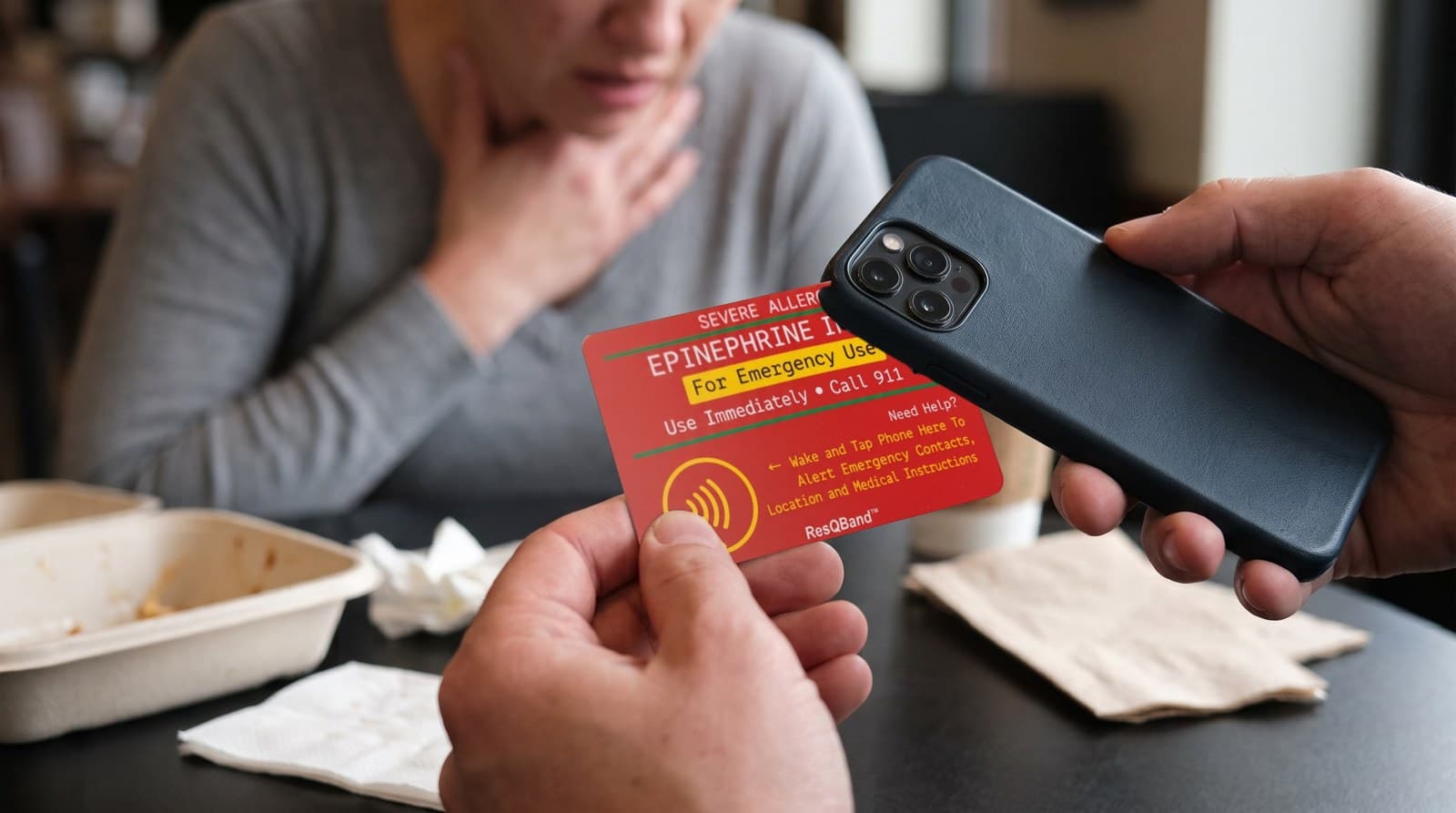
The ResQBand Tap Card is for that third habit. It's printed "Use immediately" and "Call 911", so it still works without a phone. Tapped with most phones, it opens the person's emergency page: use the epinephrine now, call 911, the maker's instructions one press away, and a button the helper can press to text the person's emergency contacts who opted in, with the helper's location when their phone shares it. See what a helper sees.
About the registry
CRAFT is a nationwide observational registry. Cases came from coroners' and medical examiners' reports, allergy associations, the medical literature and the media. The poster was presented at the 81st CSACI Annual Scientific Meeting in Toronto by Alexandre Ton That, Joseph Najem and colleagues from McGill University and centres across Canada, with senior author Moshe Ben-Shoshan. Like any registry, it can only count deaths that were recorded and found, so the true number could be higher. These are early results, presented as a poster.
This article summarises research for general information. It isn't medical advice: follow your emergency plan. In an emergency, call 911.
Sources
- Poster: The Cross-Canada Registry for Anaphylaxis Fatalities (CRAFT): demographics, triggers, co-factors and management (Ton That A, Najem J, et al.; McGill University), 81st CSACI Annual Scientific Meeting, Toronto (2026)
- 81st Annual CSACI Scientific Meeting, Toronto, October 15 to 18, 2026, Canadian Society of Allergy and Clinical Immunology (2026)
- Anaphylaxis-related deaths in Ontario: a retrospective review of cases from 1986 to 2011 (Xu YS, et al.), Allergy, Asthma & Clinical Immunology (2014)
- Epinephrine underused during anaphylaxis outside of hospital (Gabrielli et al., JACI: In Practice), McGill University Health Centre (2018)
- Mythbuster: can antihistamines and asthma medications be used instead of epinephrine to treat anaphylaxis?, Food Allergy Canada (2026)
General information, not medical advice. Always follow the instructions that come with your medication and the advice of your pharmacist or doctor. In an emergency, call 911. Medical disclaimer · How we check our articles